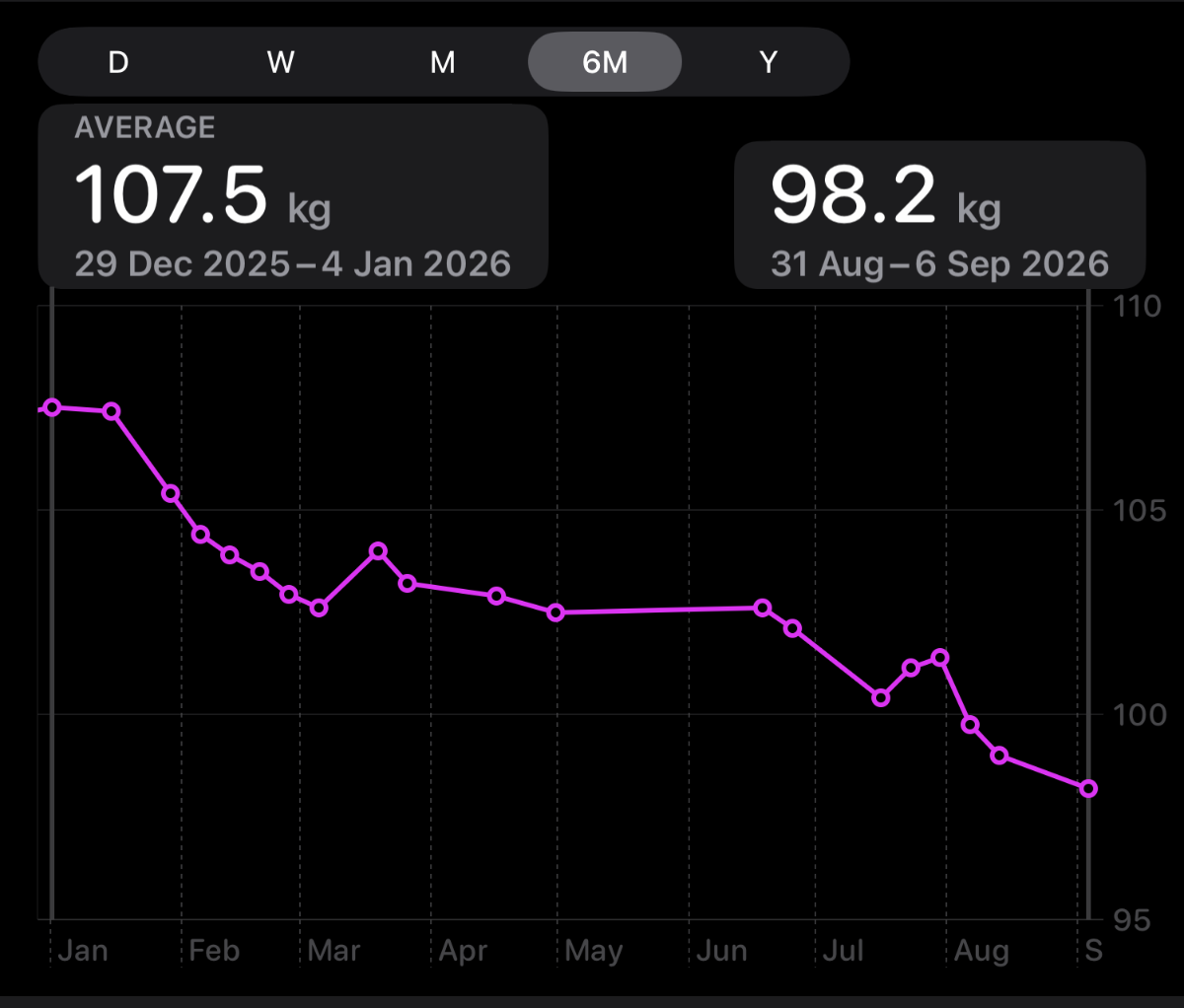
The chart above is my story since the start of this year. Or, more precisely, the story of my weight. Ten years ago I was in a similar, if not worse, situation: I started from almost 120 kg and got down to 82, only to end up big again a few years later. This time the problem was different. I am ten years older, and what worked then (essentially punishing myself with diets and dozens of kilometres of running) no longer worked. I had been trying since 2024 without much to show for it, until at the end of 2025 I finally built something I called ProsoPlate. The idea was mindful eating: mainly paying attention to what I eat and how different foods leave me feeling. Something to help me change my relationship with food.
Since January I have released several versions of the app, looking for the setup that works best. Version 1.7, the one in the App Store now, is built around something I nearly broke along the way. Here is what happened. When I was simplifying ProsoPlate for version 1.5, the pre-meal check-in looked like friction. Three questions before you are allowed to eat: how hungry are you, how strong is the pull, what are you feeling. Cut them, I thought, and logging a meal takes five seconds.
Then I understood that the point was never logging meals quickly, never just ticking them off. The checks are not data collection. They are the intervention. Everything else in the app is bookkeeping.
The loop does not run on thinking
Eating that has nothing to do with hunger runs on a habit loop: trigger, behaviour, reward. The trigger might be stress, or boredom. The hand reaches for food, the discomfort eases, and the brain files the behaviour as worth repeating. Dr. Judson Brewer has spent his career on this loop, first with smoking, then with eating. His point is uncomfortable, but it landed with me: you cannot think your way out of the loop, because the loop does not run on thinking. It runs on feeling.
From the start I kept asking myself whether I could build an app that might break this loop, and if so, how. Let’s be honest: no app will do the work for us. We have to do it ourselves, or nothing changes. At most, an app can give us a framework, a scaffold that makes the work on ourselves a little easier.
And because the loop runs on feeling, the first thing we have to do, the very first, is slow down: a moment’s pause before eating. That moment is our chance to do something other than the usual, to choose a path that is even slightly different.
Observing your own feelings has a well-established place in Buddhist psychology. The practice has a name: vedananupassana, watching feeling-tone (pleasant, unpleasant or neutral) before it hardens into craving. In plain terms: two breaths between the urge and the first bite. I wrote about what the craving feels like when you watch it, and about the brain imaging behind it.
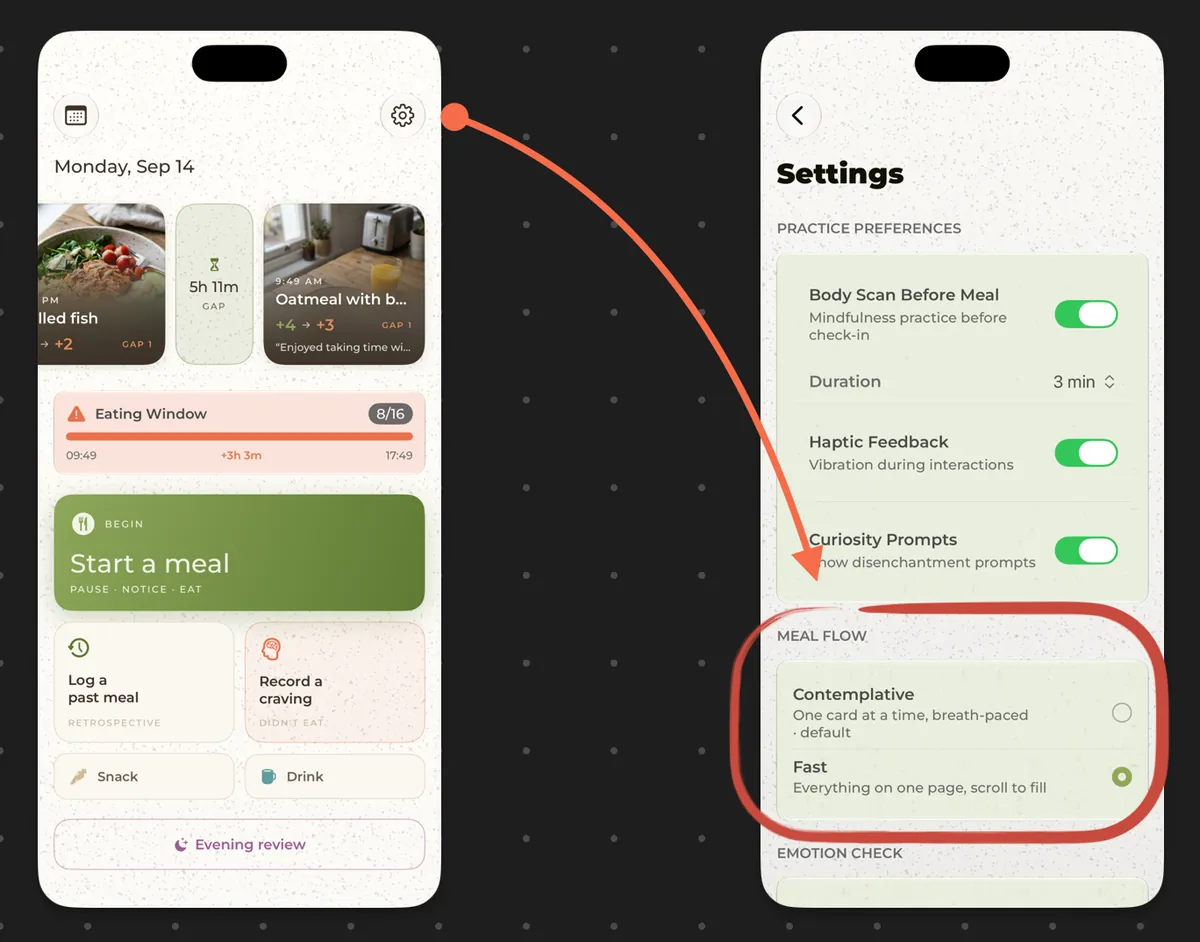
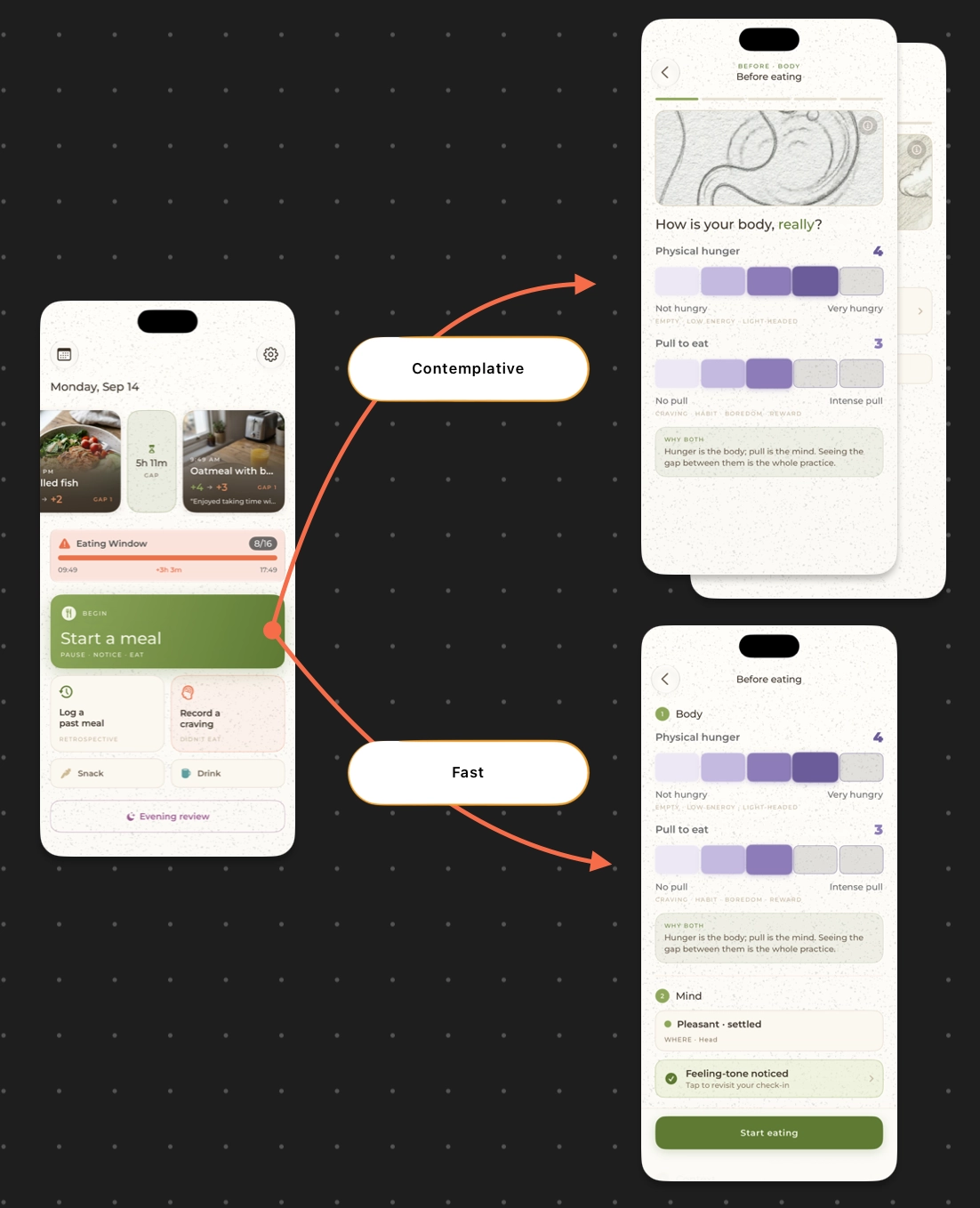
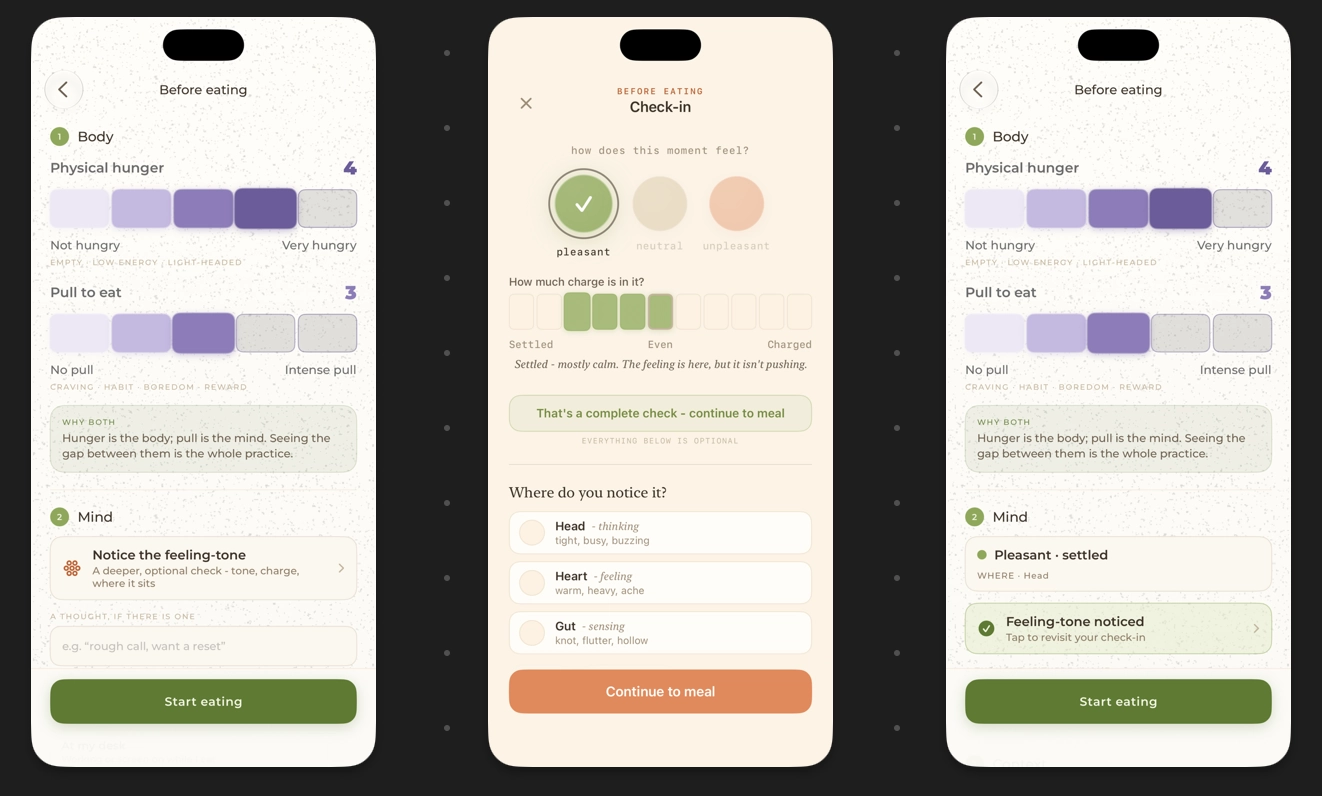
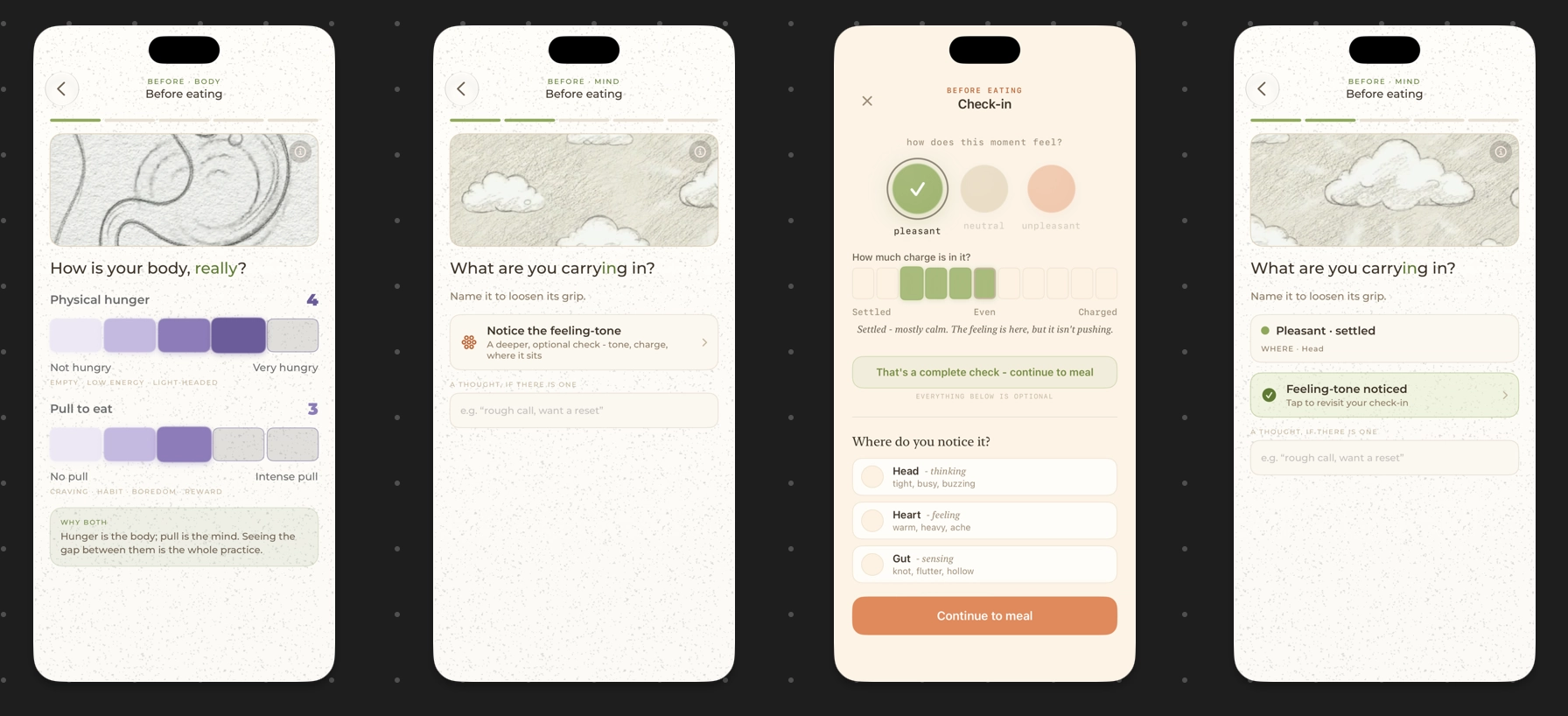
Before we get to the questions the app asks (really, the questions we should be asking ourselves), one note. During development I experimented with how a meal should be logged, and two approaches survived. I called them Contemplative and Fast. The questions and steps are the same; only the interaction differs. Contemplative, the default, walks you through one card at a time. Fast puts everything on a single scrolling page. You choose in Settings.
Three questions, not one
I built the whole check-in around essentially three questions. The app asks about the body on one card and about the mind on the next, because the questions separate signals that usually arrive fused.
Hunger is your body’s signal. It builds slowly, sits low, and accepts any food. The pull is the craving signal. It arrives suddenly, sits high, and points at one exact thing. From the inside they can feel identical, so to see the difference it helps to measure them together, side by side.
And finally, the third question, what are you feeling, names the trigger. Most non-hunger eating starts in a state, not in a stomach: restless, flat, tired, relieved. Naming the state does not fix it. It does something smaller and more useful. It puts the state in front of you instead of behind you, where it was driving.
At the end of the check-in you can add a photo and a Promise score, and… start your meal. Nothing in the app is a rule about food. It is a rule about attention.
A trial that measured it
And, to my surprise, those few small steps at the start of a meal turned out to work remarkably well for me. The truth is that at first I often forgot to reach for the app, and logged most meals after the fact. But after a few weeks, the pause before eating started to become part of every meal.
For the curious, here is what Dr. Brewer found with his own programme. His group tested app-delivered mindful eating with these ingredients. Ashley Mason and colleagues published the results in the Journal of Behavioral Medicine in 2018: 104 women with overweight or obesity, a 28-day self-paced smartphone programme built on the same reward-based learning model, with mindful eating practices aimed squarely at craving-related eating. Craving-related eating fell by about 40 percent, and three quarters of participants completed the programme.
With ProsoPlate I do it my own way, testing it on myself - and I am happy to say that it works for me.
Slow is the feature
So, back to where this article began: the checks stayed. If ProsoPlate ever feels slow in that moment before eating, good! Slow is the feature. The pause is the practice. The rest is a notebook.
You do not need the app to try it. Next time you are about to eat, ten seconds, three questions: how hungry, one to five; how strong the pull, one to five; what am I feeling, and is it pleasant or not. Then eat. You were going to eat anyway. But this time you looked first.
My goal is 80-82 kg, and there is still some way to go. Wish me luck, and all the best.
ProsoPlate is available on the App Store for £1.49. One purchase. No subscriptions. No ads.
prosoche.co - @father_bart