I built ProsoStride to get myself moving again. Not training for a marathon. Not chasing a pace. Just returning to regular walks and slow runs at an honest intensity - the kind where I could hold a conversation, where my knees stopped complaining, and where I could keep going for a year without burning out.
The method is called Niko-Niko - Japanese for “smile”. The pace at which a smile is genuine. Hiroaki Tanaka, a Japanese exercise physiologist, named it in the 1990s and used it to take his own marathon time from 4:11 to 2:38 between his thirties and his fifties. The Western world rediscovered the same idea two decades later and called it Zone 2.
The trick with Niko-Niko is not knowing about it. The trick is staying there - neither too fast (where it stops being kind to you) nor too slow (where it stops being effective). The body is bad at self-regulating to a target. Cadence - the rate at which your feet hit the ground - is the easier knob.
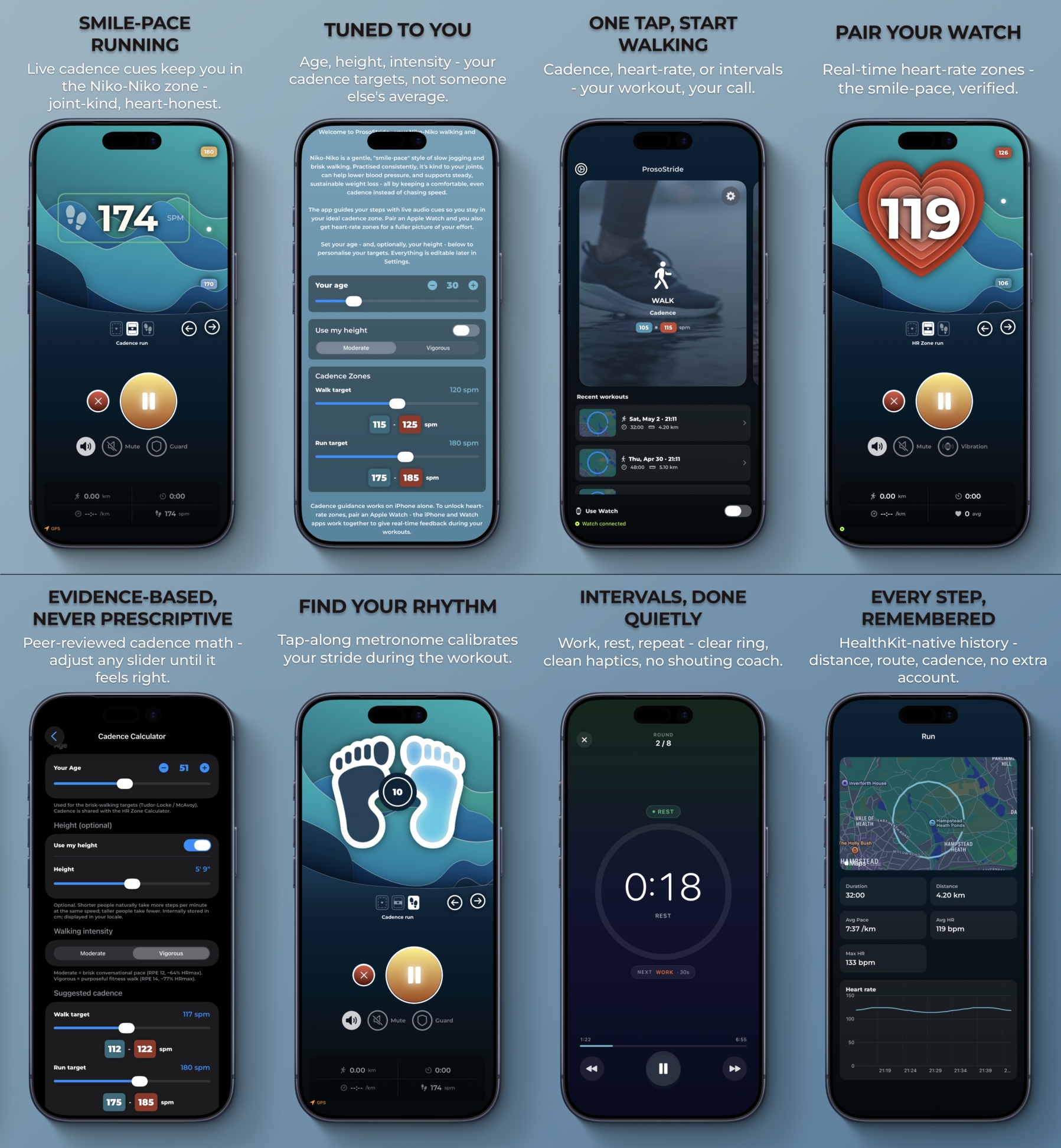
ProsoStride listens to your steps and gives you a quiet audio cue when you drift outside the band. That’s the whole feature. Everything else is decoration.
iPhone alone is enough
Cadence guidance runs on the iPhone - no Watch required. Pop the phone in a pocket or armband, plug in earbuds, walk out the door. The app uses Apple’s CoreMotion pedometer to count your steps in real time and calculates your personal cadence band from your age and (optionally) height, using peer-reviewed research - not vibes.
Pair an Apple Watch for heart-rate zones
If you have a Watch, pair it and you also get the original Niko-Niko heart-rate target - Tanaka’s formula of 138 minus half your age, with a tight band around it. “Above zone.” “In zone.” “Below zone.” Configurable, mutable, yours.
Why cadence and not pace
When you target a pace, you fight the terrain. When you target cadence, the terrain takes care of itself - your steps stay frequent and short, your speed self-regulates to whatever the slope demands, and your form holds together at slow speeds (which is exactly when most people’s form breaks down).
What it deliberately does not do
It does not yell at you. It has no “personal record”. It does not congratulate you for “crushing” anything. It does not push 7am guilt notifications. It does not gamify the practice - gamification is the opposite of what Niko-Niko is for. And it has no subscription. One purchase. Use it forever.
Privacy
All workout data goes into Apple Health, on your device. The app runs no servers, collects no analytics, and has no account to make.
If you have a feature request, drop me a line at hi-stride [at] prosoche [dot] co . I read everything.