I built ProsoPlate for myself, after years of diet cycling. Count calories, lose weight, stop counting, regain it, repeat. Somewhere in that loop I came across Dr. Judson Brewer’s research on craving and reward prediction error, and it explained why the loop never broke: restriction fights the habit from the outside. Awareness updates it from the inside.
So ProsoPlate does not count calories. It asks you to notice. What food promises before you eat, what it actually delivers after, and the gap between the two. That gap, seen honestly and often, is what does the work. I lost weight using it - not because the app told me what to eat, but because I finally saw what was going on when I ate.
How a meal goes
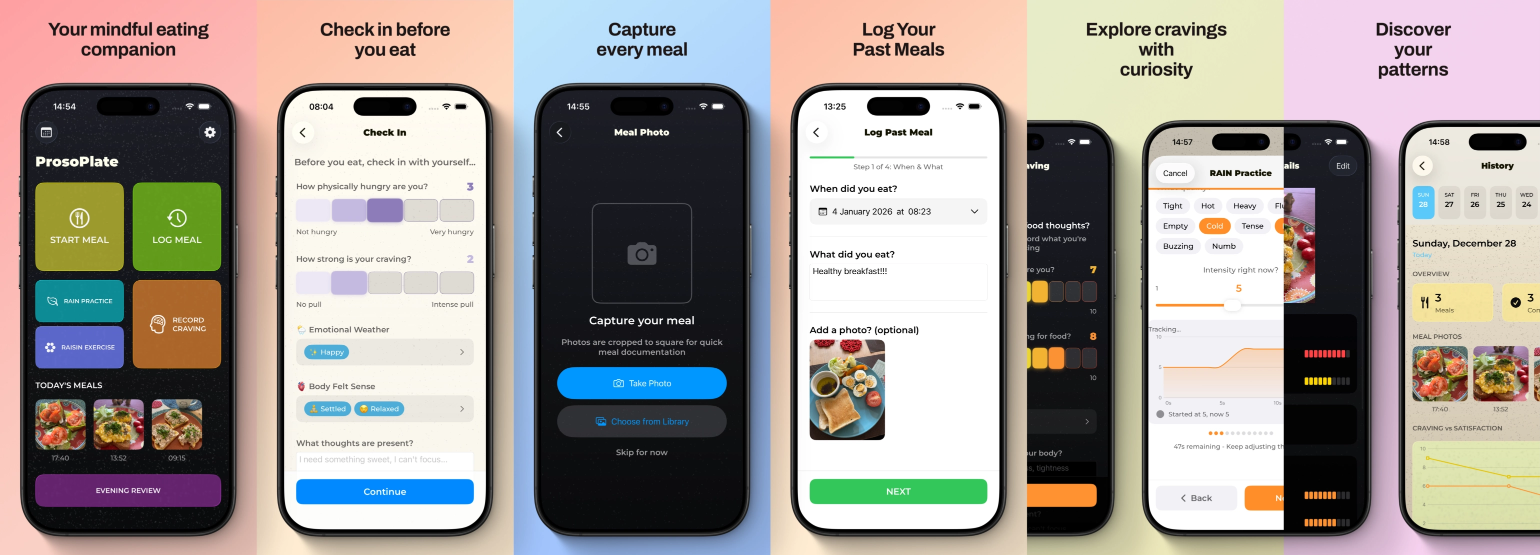
- Before you eat, three quick questions: how hungry are you, how strong is the pull, and what are you feeling. Then a photo and a Promise score - how rewarding you expect this to be. About twenty seconds. It looks like data entry. It is the practice.
- You eat. The app has nothing to say here.
- After, one number: Reality. How rewarding was that, really? Fifteen minutes later a short Clarity Check asks how your body feels now that the first rush has faded.
- In the evening, the Mindful Awareness Timeline lays the day out: cravings, meals, snacks, and the gaps between Promise and Reality. You look. Patterns turn up on their own.
What it deliberately does not do
No calorie counting. No food rules. No streaks, no targets, no red warnings. It never tells you what to eat, and it never tells you off - shame is the one thing that reliably makes eating worse, and I have tested that on myself for long enough. It shows you what you did, with curiosity rather than judgment.
The Clarity Method
The pre-meal pause, Promise, Reality and the Gap together are what I call the Clarity Method - my practical arrangement of Brewer’s work, with Kristin Neff’s self-compassion research and Tara Brach’s RAIN holding it together.
Also in there
- Snacks and drinks logged in a couple of taps, so the day looks like an actual day and not just three sit-down meals.
- An emotion check-in with eighteen research-backed emotions, and no “shame” among them.
- Time since your last meal on the home screen and in a widget, for when the honest answer to “when did I last eat?” is “no idea”.
Privacy
Everything stays on your iPhone. No account, no cloud, no analytics, nobody looking at your plate but you. Your relationship with food is personal. Your data should be too.