The first basic principle of The Buddha’s teaching, which diagnoses the problem of suffering and indicates the treatment necessary to resolve this problem.
The Four Noble Truths
- Truth of dukkha
- Truth of the origin/cause of dukkha
- Truth of the cessation of dukkha
- Truth of the path to end dukkha

Understanding the Truths
1. Dukkha - suffering, unsatisfactoriness
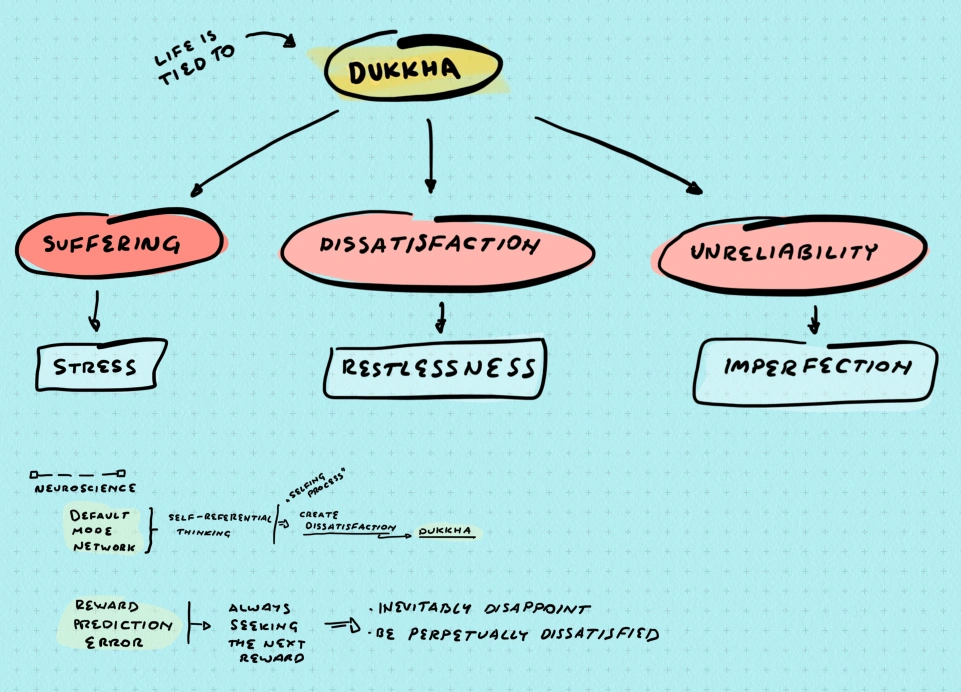
Life contains suffering. This is not pessimism - it’s a diagnosis. The Pali word dukkha goes beyond physical pain. It includes the subtle dissatisfaction of getting what you wanted and finding it wasn’t enough. The gap between what we expect and what we experience. If that sounds familiar, it’s the same mechanism Dr. Judson Brewer describes as reward prediction error - the brain predicted a reward, reality delivered less, and the mismatch generates discomfort.
2. Samudaya - the origin of dukkha
Craving (taṇhā) is the root cause. Not desire itself - but the clinging. The insistence that things be different from what they are. The Buddha identified three forms: craving for sensory pleasure, craving for existence (becoming something), and craving for non-existence (wanting things to disappear). Every time you demand that experience match your expectations, you create the conditions for dukkha. This is exactly what RAIN and the Clarity Method work with - learning to see craving clearly instead of being driven by it.
3. Nirodha - the cessation of dukkha
The pattern can end. Not by eliminating all desire, but by releasing the grip of craving. When you stop demanding that reality match your predictions, the suffering that comes from that mismatch dissolves. This isn’t a distant, unreachable state. It’s available in any moment where you see a craving clearly and let it pass without acting on it or fighting it.
4. Magga - the path
The Noble Eightfold Path is the practical method. Not a belief system - a training program. Eight interconnected practices covering how you think, how you act, and how you train your mind.
The Structure
The Four Noble Truths follow the format of ancient Indian medicine: diagnosis (dukkha), cause (samudaya), prognosis (nirodha), treatment (magga). The Buddha wasn’t building a religion. He was diagnosing a condition and prescribing a practice.
Further Reading
- Bhikkhu Bodhi, In the Buddha’s Words (2005) - systematic anthology with commentary
- Thich Nhat Hanh, The Heart of the Buddha’s Teaching (1998) - accessible entry point