The middle way: “gives rise to vision, gives rise to knowledge, and leads to peace, to direct knowledge, to enlightenment, to Nibbana”
The Path
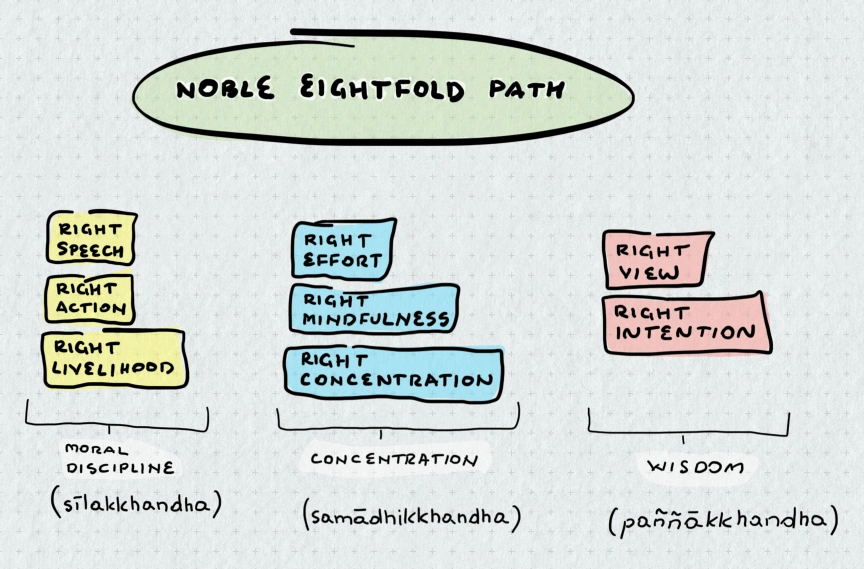
The Eightfold Path is the fourth Noble Truth - the actual practice. It’s organized into three groups: wisdom (panna), ethical conduct (sila), and mental discipline (samadhi). These are not sequential steps. They’re practiced together, each one supporting the others.
Wisdom (Panna)
1. Samma ditthi - Right View
Understanding the nature of suffering, its origin, its cessation, and the path. Seeing things as they are, not as we wish them to be. This is not blind faith - it’s direct observation. You investigate, test, and verify through your own experience.
2. Samma sankappa - Right Intention
The commitment to ethical and mental self-improvement. Three aspects: the intention of renunciation (letting go of craving), the intention of goodwill (replacing ill will with compassion), and the intention of harmlessness. Intention shapes action - what you repeatedly intend, you become.
Ethical Conduct (Sila)
3. Samma vaca - Right Speech
Speaking truthfully, kindly, and usefully. Avoiding false speech, divisive speech, harsh speech, and idle chatter. This isn’t about being nice - it’s about recognizing that words have real consequences. Speech is action.
4. Samma kammanta - Right Action
Acting in ways that don’t cause harm. The ethical foundation - not killing, not stealing, not engaging in sexual misconduct. Straightforward principles that create the stable base needed for mental training.
5. Samma ajiva - Right Livelihood
Earning a living without causing harm to others. Your work should not require deception, exploitation, or the trade of things that damage life.
Mental Discipline (Samadhi)
6. Samma vayama - Right Effort
Cultivating wholesome mental states and releasing unwholesome ones. Four aspects: preventing unarisen unwholesome states, abandoning arisen ones, cultivating unarisen wholesome states, and maintaining those already present. Not brute force - balanced, sustained effort. This maps directly to the WIN-NOGO-LOSS-ACE framework: WIN cultivates focus, NOGO prevents distraction from taking hold, LOSS recognizes when unwholesome patterns have arisen, and ACE restores balance.
7. Samma sati - Right Mindfulness
Awareness of body, feelings, mind, and mental phenomena - the four foundations described in the Satipatthana Sutta. This is the systematic training of attention that underlies the entire Prosoche approach. Not just “being present” in a vague sense, but structured observation of your own experience across four distinct domains.
8. Samma samadhi - Right Concentration
A focused, undistracted mind. The quality of collected attention that makes genuine insight possible. Developed through meditation, sustained through the support of all the other path factors.
A Direction, Not a Destination
The path is not about perfection. It’s a direction of travel - each element reinforces the others, and progress in one area naturally supports progress in the rest.
The word samma is often translated as “right,” but it also carries the meaning of “complete,” “whole,” or “balanced.” Not right versus wrong - but aligned, integrated, working together.
Further Reading
- Bhikkhu Bodhi, The Noble Eightfold Path: Way to the End of Suffering (1994) - the definitive short treatment
- Thich Nhat Hanh, The Heart of the Buddha’s Teaching (1998) - accessible and practical